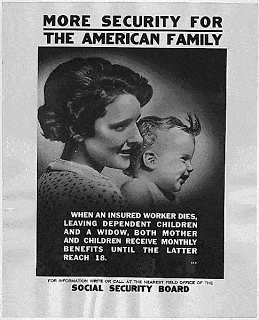
The tax result is determined by something called “combined income,” which is one-half of your Social Security income plus all your additional income (including non-taxable interest). [Read more…]

508.757.3800
Have a question? Give us a call.
Schedule Your Consultation
Would you like to meet with us?
by Kristina

The tax result is determined by something called “combined income,” which is one-half of your Social Security income plus all your additional income (including non-taxable interest). [Read more…]
by Kristina
Here’s some good news for people who live in – or are thinking of entering – a “continuing care retirement community.” These are communities for older people that provide an entire continuum of care, from independent living to nursing home, so that residents can “age in place” and not have to move elsewhere if their faculties start to diminish. These communities are an appealing option, but they can be very expensive. The good news is that there is a tax deduction available that could help defray the costs.
The tax break stems from the fact that if your medical expenses are more than 7.5 percent of your adjusted gross income (or 10 percent if you’re under age 65), you may be able to make a tax deduction for some health care costs.
Because continuing-care communities provide a full range of health services, when you enter a long-term contract with one, the IRS considers that part of your fee is a prepayment of future health care expenses. Therefore, it’s possible that you can make a tax deduction of at least part of your entrance fee and your monthly fees.
The key is that it doesn’t matter how much health care you actually receive in a given year. The percentage of your fees that is considered a prepayment of health care expenses depends on the overall, aggregate percentage of the community’s expenses that goes toward health care. This percentage varies from community to community, but is often in the 30 to 40 percent range. (Your community should be able to provide you with its exact figure.)
The deduction generally works with regard to the entrance fee only if the fee is non-refundable. However, if the entrance fee is only partially non-refundable, you might be able to take a deduction based on the non-refundable portion.
You should also know that if children or other family members help a resident to pay the entrance fee or monthly expenses, they might also be eligible for the tax break.
When you’re ready to discuss your next step in elder residence, contact Attorney Kristina Vickstrom at 508-757-3800.
by Kristina
Occasionally, I run across a great article written by someone else. Today is one of those days and I just had to share it with you. Clients are often confused when they come in for initial consultations and have preconceived notions about planning their estates based on things that they’ve heard from their friends, neighbors, hairdresser, etc. Most of the time the information shared is incorrect, or at least incorrectly applied to their situation. This article does a great job of debunking the most popular “myths” of estate planning. I only added one little thought in bold below. Thank you to my colleague, Attorney Gina Barry, from Bacon & Wilson in Springfield for putting this article together…. and as far as I know unicorns are still mythical creatures. [Read more…]
by Kristina
One year ago, President Obama appointed a Task Force on the Middle Class to create a plan to help middle class families get back on their feet and bring our economy out of recession. Recently, this task force announced its recommendations, which included a $102.5 million Caregiver Initiative, and a plan to secure your retirement funds. [Read more…]
by Kristina
As we all know, tax season has been in full swing for many weeks now, and it is almost over for some. But, did you know that even if you did not have to file a tax return, as a senior, it may be beneficial for you to do so? Did you know there is a tax credit only available to seniors in Massachusetts who pay rent or real estate taxes? There is, and it is called the Circuit Breaker Tax Credit. Even if you don’t owe any taxes at all, you may be eligible for this credit, and it is just like money in your pocket (Certain counties in Massachusetts, including Worcester and Middlesex, have had tax deadlines extended to May 15th, because they have been declared Federal Disaster Areas due to the recent floodings). [Read more…]
by Kristina
Hardly a day goes by when I don’t have a client who tells me that they can give away a certain amount of money free and clear, avoiding look-back periods for long-term care planning. They inform me that their neighbor, friend, or cousin told them that this is allowable. I then have the unfortunate task of telling them that they are wrong and that most states that have enacted the Deficit Reduction Act. After February 8, 2006, the rules relative to gifts changed.
Regardless of the amount, any gift that is made is a transfer and is subject to a look-back period of five-years for MassHealth (Medicaid) purposes. This doesn’t mean that the State will take that money, but rather, that the State will not pay for the donor’s long-term care costs until the five-year look-back is exhausted, or in the alternative, until all the gifts that have been transferred are used to pay for the institutionalized person’s care. [Read more…]
Have a question? Give us a call.
508.757.3800
Want to leave us a review?
Review Vickstrom Law